Select the Right Heat Exchanger in Minutes
Our in-house calculation engine runs thermal and hydraulic verification on real plate geometries, then finds the suitable model and the minimum plate count.
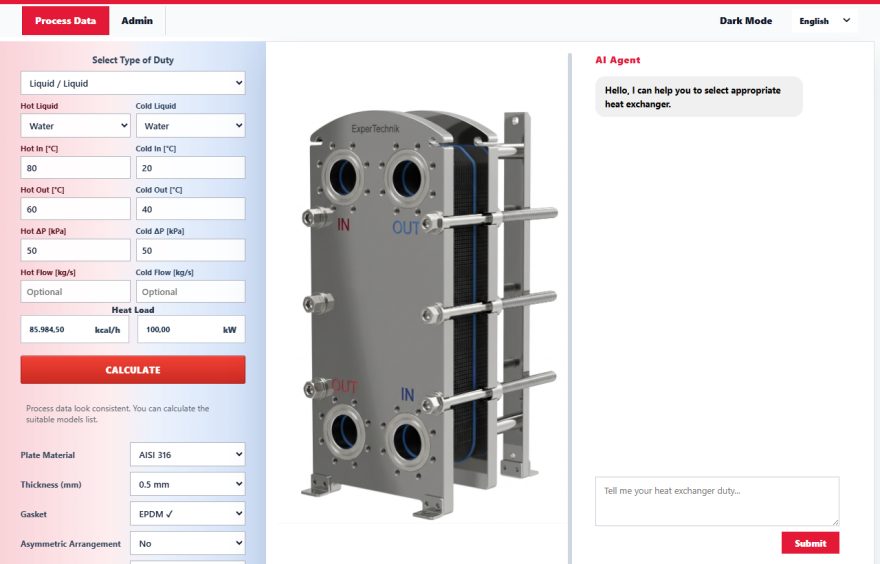
Selection Quality Drives Cost and Delivery Time
Fast, Reliable Selection
Instead of hours in manual spreadsheets, you enter the process data and get a list of suitable models within seconds.
Minimum Viable Plate Count
Oversizing is cost. The engine calculates the smallest plate count that still meets the heat duty and the pressure drop limits.
Thermal and Hydraulic Verification
Every selection is checked on two axes: is the required heat transfer achieved, and does the pressure drop stay within limits on both fluid sides.
Shorter Quotation Cycle
Selection, datasheet and quotation output are produced in a single flow, removing the back-and-forth between engineering and sales.
What Is Inside the Engine?
The calculation chain follows how a plate heat exchanger is actually sized: it starts from the heat duty and ends at channel geometry and pressure drop limits.
-
1
Heat Duty and LMTD
Heat duty is calculated from process temperatures and flow rates; the log mean temperature difference and its correction factor are determined for counter-current flow.
-
2
Overall Heat Transfer Coefficient (U)
Film coefficients on both sides come from Nusselt correlations tied to the plate geometry, and combine with plate conduction and fouling resistance into the U value.
-
3
Plate Count
The plate count follows from the required heat transfer area and the effective plate area of the selected model, and is reported together with the thermal reserve.
-
4
Channel Configuration
Single and multi-pass arrangements, parallel channel distribution and flow direction; hot and cold side channel counts are set per model.
-
5
Pressure Drop Check
Channel and port losses are computed separately; a selection is rejected if the allowed pressure drop is exceeded on either side.
From Process Data to Datasheet
Input
Fluids, inlet/outlet temperatures, flow rate or heat duty, allowed pressure drop, material and gasket preferences.
Calculation
The engine runs the thermal and hydraulic calculation across the candidate models in the catalogue.
Model Comparison
Feasible models are listed side by side with plate count, reserve and pressure drop.
Selection
The model is fixed according to project constraints; channel arrangement and connections are finalised.
Datasheet
The selection result is turned into a technical datasheet and quotation output.
What You Get on Screen
- Technical Selection Result Heat duty, LMTD, U value, thermal reserve and pressure drop for both sides in a single table.
- Model and Plate Count Selected model, plate count, channel arrangement and effective heat transfer area.
- Material Selection Plate material and thickness, gasket type, and their suitability for the process temperature and fluid.
- Ports and Connections Connection size and type, port velocities and their effect on pressure drop.
- Datasheet and Quotation A technical datasheet ready to send to your customer, carrying your own logo in private-label use.
What Sets It Apart From Other Selection Tools?
Independent
We are not tied to a single manufacturer catalogue. The selection follows the project requirement, not the model we would like to sell.
Engineering First
Thermal and hydraulic verification run together: even if the heat transfer is met, a selection is rejected when the pressure drop limit is exceeded.
Flexible Use
The same engine can be used through us, with distributor access, as private label or as a franchise.
Open to Your Brand
It can be deployed on your own domain, with your own catalogue, plate database and logo.
Fast Result
The path from process data to a professional datasheet and quotation is measured in minutes, not days.
How You Can Use the Software
The same engine can be used in different ways, depending on how mature your business is.
Through ExperTechnik
You send us the project; we run the selection and prepare the datasheet and quotation.
Distributor Access
Access to the software so you can run selections for your own customers and prepare the quotation yourself.
Private Label
Datasheets and technical documents are produced under your own brand and logo.
Software Franchise
A selection program running on your own domain, with your own catalogue and plate database.
Why You Can Trust These Results
Our Own Calculation Engine
We do not rely on a licensed calculation library; the thermal and hydraulic model is ours. We can explain the calculation steps, the geometry used and the selection criteria in a traceable way.
Real Model Geometries
The calculation works with real geometric data: plate size, channel geometry, port diameter and effective area.
Thermal and Hydraulic Validation
Results are compared regularly against reference manufacturer selection data and validated project results; where a deviation appears, its root cause is investigated.
Continuous Calibration
Heat transfer and pressure drop coefficients are recalibrated as new data arrives, and every change is recorded.
Try the Software on Your Own Project
Let us run a selection with real process data and review the result and the datasheet together.